Kamis, 16 Juni 2011

Catatan analisis perancangan jaringan komputer

Fitur-Fitur Dalam Perancangan Jaringan
1. Service
  • Ip Otomatis
  • DHCP (Dinamis Host Configuration Protocol). DHCP Relay yaitu service yang meneruskan IP secara otomatis. DHCP Authentifikasi berupa MAC ADdress.
Dynamic Host Configuration Protocol (DCHP) adalah protokol yang berbasis arsitektur client/server yang dipakai untuk memudahkan pengalokasian alamat IP dalam satu jaringan. Sebuah jaringan lokal yang tidak menggunakan DHCP harus memberikan alamat IP kepada semua komputer secara manual. Jika DHCP dipasang di jaringan lokal, maka semua komputer yang tersambung di jaringan akan mendapatkan alamat IP secara otomatis dari server DHCP. Selain alamat IP, banyak parameter jaringan yang dapat diberikan oleh DHCP, seperti default gateway dan DNS server.
  • RADIUS (Remote Access Dial In User Service). Digunakan untuk jarak jauh.
Remote Authentication Dial-In User Service (sering disingkat menjadi RADIUS) adalah sebuah protokol keamanan komputer yang digunakan untuk melakukan autentikasi, otorisasi, dan pendaftaran akun pengguna secara terpusat untuk mengakses jaringan. RADIUS didefinisikan di dalam RFC 2865 dan RFC 2866, yang pada awalnya digunakan untuk melakukan autentikasi terhadap akses jaringan secara jarak jauh dengan menggunakan koneksi dial-up. RADIUS, kini telah diimplementasikan untuk melakukan autentikasi terhadap akses jaringan secara jarak jauh dengan menggunakan koneksi selain dial-up, seperti halnya Virtual Private Networking (VPN), access point nirkabel, switch Ethernet, dan perangkat lainnya.
Radius banyak dipakai oleh Provider dan ISP internet untuk authentikasi dan billingnya. Radius juga bisa dipakai oleh jaringan RT/RW-Net untuk authentikasi para penggunanya dan untuk mengamankan jaringan RT/RW-Net yang ada. Di indonesia sudah ada service radius, namun berbayar seperti indohotspot.net . Ada juga service yang tidak berbayar, dan dikelola oleh luar negeri seperti chillidog.org Selain lebih menghemat budget, dan juga menghemat biaya maintenance, sistem Radius yang di host di internet merupakan salah satu solusi murah untuk para penggagas sistem HotSpot.
  • LDAP
LDAP (Lightweight Directory Access Protocol) adalah protokol perangkat lunak untuk memungkinkan semua orang mencari resource organisasi, perorangan dan lainnya, seperti file atau printer di dalam jaringan baik di internet atau intranet. Protokol LDAP membentuk sebuah direktori yang berisi hirarki pohon yang memiliki cabang, mulai dari negara (countries), organisasi, departemen sampai dengan perorangan. Dengan menggunakan LDAP, seseorang dapat mencari informasi mengenai orang lain tanpa mengetahui lokasi orang yang akan dicari itu.
2. Monitoring
  • SNMP(Simple Network Management Protocol).
Simple Network Management Protocol (SNMP) merupakan protokol standard industri yang digunakan untuk memonitor dan mengelola berbagai perangkat di jaringan Internet meliputi hub, router, switch, workstation dan sistem manajemen jaringan secara jarak jauh (remote). Baru-baru ini (pertengahan Februari 2002) Oulu University Secure Programming Group, sebuah group riset keamanan jaringan di Finlandia, telah menemukan adanya kelemahan pada SNMP v1.
Kelemahan tersebut memungkinkan seorang cracker memasang back door pada peralatan yang menggunakan SNMP v1 sehingga bisa menyusup ke jaringan dan melakukan apa saja terhadap jaringan. Kelemahan ditemukan pada SNMP trap and request facilities yang memungkinkan penyusup memperoleh akses ke dalam sistem yang menjalankan SNMP dan melakukan serangan Denial of Service (DoS) yang membuat sistem tidak berfungsi (down) atau tidak stabil.
  • MRTG
MRTG (the Multi Router Traffic Grapher) Adalah aplikasi yang digunakan untuk memantau beban trafik pada link jaringan. MRTG akan membuat halaman HTML yang berisi gambar GIF yang mengambarkan trafik melalui jaringan secara harian, mingguan, bulanan dan tahunan. MRTG dibuat oleh Tobias Oetiker menggunakan Perl dan C dan tersedia untuk sistim operasi UNIX dan Windows NT.
3. Routing Dinamis
  • OSPF
Open Shortest Path First (OSPF) adalah sebuah routing protokol standar terbuka yang telah di implementasikan oleh sejumlah besar vendor jaringan.
OSPF bekerja dengan sebuah algoritma yang disebut Dijkstra. Pertama, sebuah pohon jalur terpendek (shortest path tree) akan dibangun, dan kemudian routing table akan diisi dengan jalur terbaik yang dihasilkan dari pohon tersebut. OSPF melakukan converge dengan cepat, meskipun tidak secepat EIGRP, dan OSPF mendukung multiple route dengan biaya (cost) yang sama, ketujuan yang sama.
  • RIP
Routing Information Protocol (RIP) adalah sebuah protokol routing dinamis yang digunakan dalam jaringan LAN (Local Area Network) dan WAN (Wide Area Network). Karena itu protokol ini diklasifikasikan sebagai Interior Gateway Protocol (IGP). Protokol ini menggunakan algoritma Distance-Vector Routing. Pertama kali didefinisikan dalam RFC 1058 (1988). Protokol ini telah dikembangkan beberapa kali, sehingga terciptalah RIP Versi 2 (RFC 2453). Kedua versi ini masih digunakan sampai sekarang, meskipun begitu secara teknis mereka telah dianggap usang oleh teknik-teknik yang lebih maju, seperti Open Shortest Path First (OSPF) dan protokol OSI IS-IS. RIP juga telah diadaptasi untuk digunakan dalam jaringan IPv6, yang dikenal sebagai standar RIPng (RIP Next Generation / RIP generasi berikutnya), yang diterbitkan dalam RFC 2080 (1997).
  • BOP

Catatan analisis perancangan jaringan komputer

Mensetting Virtual Virtual Mesin(VMware)
Pada pertemuan kali ini, kita membahas cara mensetting Vmware:
  1. Setting Virtual mesin di PC komputer
  2. Koneksikan dengan jaringan melalui Acses Point (dalam hal ini Linksys)
  3. Settinglah IP PC Komputer virtual (Misalnya: ifconfig eth0 192.168.1.2)
  4. Chek kompter yang aktif beserta MAC Addressnya yang berada dalam jaringan. (Misalnya ping 192.168.1.102)
Berikut perintah-perintah yang di masukkan:
ip config/ all  —->(windost, host, mac address, Ip address)
nmap – Sp 192.168.1.1 -254 –> untuk menchek host yang konek
nmap -0 192.168.1.1 -254
nmap -OS 192.168.1.1 -254
starx –> perintah untuk merubah linux dengan tampilan grafik
lalu lakukan login dengan cara: telnet_IPsendiri –> masuk (inputkan username dan password).

Catatan analisis perancangan jaringan komputer

Merancang jaringan 5 Gedung
Materi perkuliahan kali ini adalah dengan mempresetasikan kerja kelompok. Adapun prinsip yang dapat dikembangkan yaitu:
  1. Untuk perancangan antar gedung , digunakan prinsip routing, prinsip ini dapat menghubungkan segmen jaringan yang berbeda dengan menggunakan router.
  2. Untuk perncangan jaringan internal atau dalam gedung dapat menggunakan teknik subnetting.
  3. Topologi yang digunakan yaitu topoli mesh untuk antar gedung dan topologi star untunk internal dalam gedung
  4. Untuk mencegah jaringan terputus dan memberikan alternatif makan diberikan pula dua buah koneksi internet.
  5. Sebenarnya konsep ini masih memiliki kelemahan yakni boros kabel.
Hardware Yang di Butuhkan
  1. Router
  2. Swicth
  3. PC komputer
  4. Kabel jaringan
  5. Wifi Hotspot terdapat pada gedung C
Konsep Perancangan
Perancangan jaringan ini menggunakan teknik bridge, dengan topologi mesh untuk di antar gedung, dan topologi star untuk dalam gedung.
Gedung A
Pada Gedung A ini ada 2 lantai, untuk tiap lantai memerlukan 2 buah switch yang mana setiap lantai memiliki jumlah host 10 buah. Pada gedung ini dibagi menjadi 2 segmen jaringan, dengan teknik subnetting Kemudian untuk konfigurasi IP kita menggunakan 192.168.101.0 /27
Kemudian IP 192.168.101.1   dipakai untuk gateway jaringan yang terpasang pada router.
Gedung B
Pada Gedung B ini ada 2 lantai, untuk tiap lantai memerlukan 2 buah switch yang mana setiap lantai memiliki jumlah host 10 buah. Pada gedung ini dibagi menjadi 2 segmen jaringan, dengan teknik subnetting Kemudian untuk konfigurasi IP kita menggunakan 192.168.102.0 /27
Kemudian IP 192.168.102.1 dipakai untuk gateway jaringan yang terpasang pada router.
Gedung C
Pada Gedung C ini ada 2 lantai, untuk tiap lantai memerlukan 2 buah switch yang mana setiap lantai memiliki jumlah host 10 buah. Pada gedung ini dibagi menjadi 2 segmen jaringan, dengan teknik subnetting Kemudian untuk konfigurasi IP kita menggunakan 192.168.103.0 /27. Khusus lantai 1 kita menggunakan layanan wireless dan konfigurasi IP client di atur oleh DHCP.
Kemudian IP 192.168.103.1 dipakai untuk gateway jaringan yang terpasang pada router.
Gedung D
Pada Gedung D ini ada 2 lantai, untuk tiap lantai memerlukan 2 buah switch yang mana setiap lantai memiliki jumlah host 10 buah. Pada gedung ini dibagi menjadi 2 segmen jaringan, dengan teknik subnetting Kemudian untuk konfigurasi IP kita menggunakan 192.168.104.0 /27
Kemudian IP 192.168.104.1 dipakai untuk gateway jaringan yang terpasang pada router.
Gedung E
Pada Gedung E ini ada 2 lantai, untuk tiap lantai memerlukan 2 buah switch yang mana setiap lantai memiliki jumlah host 10 buah. Pada gedung ini dibagi menjadi 2 segmen jaringan, dengan teknik subnetting Kemudian untuk konfigurasi IP kita menggunakan 192.168.105.0 /27
Kemudian IP 192.168.104.1 dipakai untuk gateway jaringan yang terpasang pada router.Untuk lebih detailnya lihat pada perancangan jaringan di bawah ini:


Selasa, 07 Juni 2011

Catatan analisis perancangan jaringan komputer

Merancang jaringan 5 Gedung
Materi perkuliahan kali ini adalah dengan mempresetasikan kerja kelompok. Adapun prinsip yang dapat dikembangkan yaitu:
  1. Untuk perancangan antar gedung , digunakan prinsip routing, prinsip ini dapat menghubungkan segmen jaringan yang berbeda dengan menggunakan router.
  2. Untuk perncangan jaringan internal atau dalam gedung dapat menggunakan teknik subnetting.
  3. Topologi yang digunakan yaitu topoli mesh untuk antar gedung dan topologi star untunk internal dalam gedung
  4. Untuk mencegah jaringan terputus dan memberikan alternatif makan diberikan pula dua buah koneksi internet.
  5. Sebenarnya konsep ini masih memiliki kelemahan yakni boros kabel.
           Lihat gambar berikut ini:
Gambar Jaringan Internal dalam Gedung , seperti berikut:

Catatan analisis perancangan jaringan komputer

Mensetting Virtual Virtual Mesin(VMware)
Pada pertemuan kali ini, kita membahas cara mensetting Vmware:
  1. Setting Virtual mesin di PC komputer
  2. Koneksikan dengan jaringan melalui Acses Point (dalam hal ini Linksys)
  3. Settinglah IP PC Komputer virtual (Misalnya: ifconfig eth0 192.168.1.2)
  4. Chek kompter yang aktif beserta MAC Addressnya yang berada dalam jaringan. (Misalnya ping 192.168.1.102)
Berikut perintah-perintah yang di masukkan:
ip config/ all  —->(windost, host, mac address, Ip address)
nmap – Sp 192.168.1.1 -254 –> untuk menchek host yang konek
nmap -0 192.168.1.1 -254
nmap -OS 192.168.1.1 -254
starx –> perintah untuk merubah linux dengan tampilan grafik
lalu lakukan login dengan cara: telnet_IPsendiri –> masuk (inputkan username dan password)

Catatan analisis perancangan jaringan komputer

Perancangan Jaringan komputer 2 Gedung
Perancangan ini dengan menggunakan sistem bridge:
Silahkan lihat gambar:

Catatan analisis perancangan jaringan komputer

Syarat komputer dengan komputer yang saling terhubung adalah sebagai berikut, komputer tersebut harus berada pada:
1. Net id yang sama
2. host id tidak boleh sama
3. network yang sama
4. IP broadcast-nya sama
Tugas
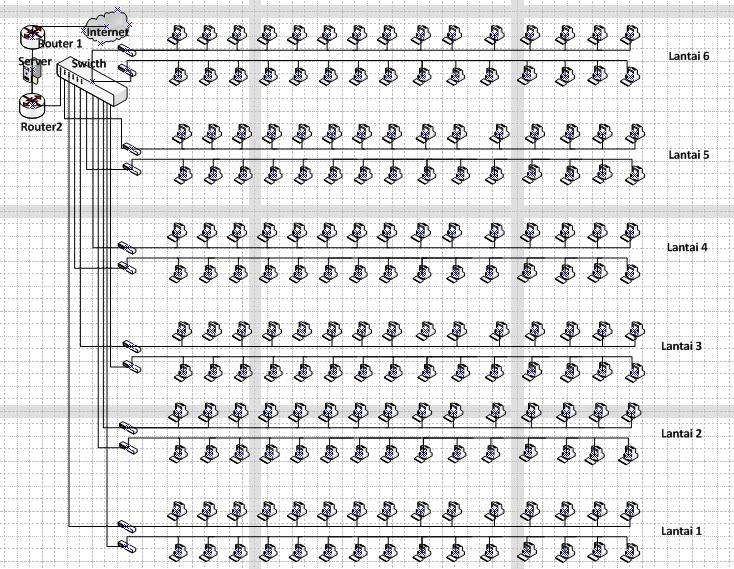
merakit jaringan komputer 6 lantai dengan masing-masing 30 PC perlantai.

Catatan analisis perancangan jaringan komputer

Hacker adalah seseorang yang mencoba masuk kedalam suatu jaringan secara paksa dengan tujuan mengambil keuntungan, tatpi bersifat merusak. Seseorang yang sangat senang mengeksplorasi suatu program dari suatu system untuk untuk mengetahui batas kemampuannya, dengan mengunakan cara-cara dasar yang akan digunakan oleh orang yang tidak mengerti dan mengetahui bagaimana program itu dibuat dan dengan pengetahuan minimum terhadap program.
Craker adalah seseorang yang mencoba masuk kedalam suatu jaringan secara paksa dengan tujuan mengambil keuntungan, merusak, dsb.

Langkah hacking system:
1. Foot printing
yaitu mencari rincian informasi terhadap sistem untuk dijadikan sasran, mencakup pencarian informasi dengan searching engine, who is, dan DNS zone transfer
2. Scanning
terhadap sasaran tertentu dicari pintu masuk yang paling mungkin, digunakan ping sweep dan port scan.
3. Enumeration
Telaah intersif terhadap sasaran yang mencari user account, network resources dan share dan aplikasi untuk mendapatkan mana yang proteksinya lemah.
4.Gaining Acces
Mendapatkan data lebih banyak lagi untuk mulai mencoba mengakses sasaran.
5. Escalating privilege
Bila baru mendapatkan user password ditahap sebelumnya. Ditahap ini diusahakan mendapatkan privilese admin jaringan dengan password cracking atau exploit sejenis getAdmin, schole atau ls message
6. Pilfering
7. Covering tracks
8. Creating Back Doors
9. Denial of Service

Catatan analisis perancangan jaringan komputer

Struktur kabel
Specifies:
  • Cabling requirements
  • Cabling distances
  • Outlet / connector configurations
  • Recommended topology
  • Covers wide range of building sites and
applications
  • Voice, data, text, video, image, etc.
  • Up to 1,000,000 m2 office space
  • Up to 50,000 users
Sttrructturred Cablliing:: Why?
  • Provides flexibility
  • Supports diverse environments
  • Ensures reliable, high performance
  • Allows for quick moves, adds, changes

Pengertian Struktur Kabel
• Adalah sebuah sistem struktur yang bekerja berdasarkan prinsip gaya tarik, terdiri atas kabel baja, sendi, batang, dsb yang menyanggah sebuah penutup yang menjamin tertutupnya sebuah bangunan. (Makowski, 1988)
• Struktur kabel dan jaringan dapat juga dinamakan struktur tarik dan tekan, karena pada kabel-kabel hanya dilimpahkan gaya-gaya tarik, sedangkan kepada tiang-tiang pendukungnya hanya dilimpahkan gaya tekan. (Sutrisno, 1983)
Sejarah Struktur Kabel
A. Sejarah Perkembangan Struktur Kabel
Asal mula struktur kabel
Struktur kabel merupakan salah satu struktur tradisional yang awalnya berupa jembatan dan tenda. Jembatan dengan sistem kabel tarik awalnya diterapkan pada daerah pegunungan seperti Himalaya atau di daerah hutan hujan seperti Peru. Kemudian berkembang hingga Eropa
yang diprakarsai oleh Faustus Verantinus pada tahun 1616 yang menggunakan rantai sebagai pengganti kabel yang dingkurkan pada menara. Pada saat itu hingga menjelang abad ke-20, kabel hanya menjadi sistem yang membantu perkuatan karena belum dapat mengatasi factor beban angin.
Bentuk tenda sering digunakan oleh suku nomaden di Eropa Utara, Asia dan Timur Tengah. Tenda-tenda tersebut dapat dikelompokkan atas tiga jenis, yaitu :
1. Bentuk kerucut dengan penutup dari kulit
Merupakan bentuk yang paling sederhana dengan satu atau lebih tiang utama di dalam dan beberapa tiang pembentuk yang menyatu di puncak tiang utama.
2. Bentuk silinder dengan atap perpaduan bentuk kubah dan kerucut
Dinding silinder dibentuk dengan batang-batang yang saling menyilang dengan batang pembentuk atap menyatu ditengah dan diperkuat dengan cincin
3. Bentuk black tent
Bentuk ini hanya menggunakan kabel tarik yang ditutupi terpal tanpa batang pengaku. Fungsi utamanya adalah sebagai perlindungan terhadap matahari dan temperature yang rendah pada malam hari.
Keuntungan dan Kelemahan Struktur Kabel
• Keuntungan struktur kabel :
1. Elemen kabel merupakan elemen konstruksi paling ekonomis untuk menutup permukaan yang luas
2. Ringan, meminimalisasi beban sendiri sebuah konstruksi
3. Memiliki daya tahan yang besar terhadap gaya tarik, untuk bentangan ratusan meter mengungguli semua sistem lain
4. Memberikan efisiensi ruang lebih besar
5. Memiliki faktor keamanan terhadap api lebih baik dibandingkan struktur tradisonal yang sering runtuh oleh pembengkokan elemen tekan di bawah temperatur tinggi. Kabel baja lebih dapat menjaga konstruksi dari temperatur tinggi dalam jangka waktu lebih panjang, sehingga mengurangi resiko kehancuran
6. Dari segi teknik, pada saat terjadi penurunan penopang, kabel segera menyesuaikan diri pada kondisi keseimbangan yang baru, tanpa adanya perubahan yang berarti dari tegangan
7. Cocok untuk bangunan bersifat permanen.
• Kelemahan struktur kabel :
Pembebanan yang berbahaya untuk struktur kabel adalah getaran. Struktur ini dapat bertahan dengan sempuna terhadap gaya tarik dan tidak mempunyai kemantapan yang disebabkan oleh pembengkokan, tetapi struktur dapat bergetar. Dalam hal gejala resonansi yang umum dikenal dapat timbul dan mengakibatkan robohnya bangunan.

Disain dan Analisis Keamanan jaringan 7 / Pengertian SSH (Secure Shell) dan SSL (Secure Socket Layer)

  1. Pengertian SSH (Secure Shell) dan SSL (Secure Socket Layer)
Pada awalnya SSH dikembangkan oleh Tatu Yl nen di Helsinki University of Technology. SSH memberikan alternatif yang secure terhadap remote session tradisional dan file transfer protocol seperti telnet dan relogin.Protokol SSH mendukung otentikasi terhadap remote host, yang dengan demikian meminimalkan ancaman pemalsuan identitas client lewat IP address spoofing maupun manipulasi DNS. Selain itu SSH mendukung beberapa protokol enkripsi secret key (DES,TripleDES,IDEA, dan Blowfish) untuk membantu memastikan privacy dari keseluruhan komunikasi, yang dimulai dengan username/password awal.SSH menyediakan suatu virtual private connection pada application layer, mencakup interactive logon protocol (ssh dan sshd) serta fasilitas untuk secure transfer file (scd). Setelah meng-instal SSH, sangat dianjurkan untuk mendisable telnet dan rlogin. Implementasi SSH pada linux diantaranya adalah OpenSSH.
SSH merupakan paket program yang digunakan sebagai pengganti yang aman untuk rlogin, rsh dan rcp. Ia menggunakan public-key cryptography untuk mengenkripsi komunikasi antara dua host, demikian pula untuk autentikasi pemakai. Ia dapat digunakan untuk login secara aman ke remote host atau menyalin data antar host, sementara mencegah man-in-themiddle attacks (pembajakan sesi) dan DNS spoofing atau dapat dikatakan Secure Shell adalah program yang melakukan loging terhadap komputer lain dalam jaringan, mengeksekusi perintah lewat mesin secara remote, dan memindahkan file dari satu mesin ke mesin lainnya. SSL (Secure Socket Layer) dikembangkan oleh Netscape untuk mengamankan HTTP dan sampai sekarang masih inilah pemanfaatan utama SSL. SSL menjadi penting karena beberapa produk umum seperti Netscape Communicator, Internet Explorer, dan WS_FTP Pro, yang merupakan produk yang lazim digunakan, menggunakan SSL. Secure Sockets Layer, adalah metode enkripsi yang dikembangkan oleh Netscape untuk memberikan keamanan di Internet. Ia mendukung beberapa protokol enkripsi dan memberikan autentikasi client dan server. SSL beroperasi pada layer transpor, menciptakan saluran enkripsi yang aman untuk data, dan dapat mengenkripsi banyak tipe data. Hal ini dapat dilihat ketika mengunjungi site yang aman untuk melihat dokumen online aman dengan Communicator, dan berfungsi sebagai dasar komunikasi yang aman dengan Communicator, juga dengan enkripsi data Netscape Communication lainnya. Atau dapat dikatakan bahwa SSL merupakan Protokol berlapis. Dalam tiap lapisannya, sebuah data terdiri dari panjang, deskripsi dan isi. SSL mengambil data untuk dikirimkan, dipecahkan kedalam blok-blok yang teratur, kemudian dikompres jika perlu, menerapkan MAC, dienkripsi, dan hasilnya dikirimkan. Di tempat tujuan, data didekripsi, verifikasi, dekompres, dan disusun kembali. Hasilnya dikirimkan ke klien di atasnya.
2. Kegunaan SSH dan SSL
SSL dirancang untuk mengamankan sesi web, sedangkan SSH dirancang untuk menggantikan protokol telnet dan FTP. Keduanya mempunyai banyak fitur lain, tetapi tujuan utamanya memang untuk mengamankan komunikasi melalui internet.
SSL telah digunakan untuk mengamankan protokol-protokol yang insecure menjadi secure. SSL menjadi perantara antara pemakai dengan protokol HTTP dan menampilkan HTTPS kepada pemakai. Hal yang sama dapat dilakukan pula terhadap protokol-protokol insecure lain seperti POP3, SMTP, IMAP dan apasaja yang merupakan aplikasi TCP.
Adapun SSH merupakan produk serbaguna yang dirancang untuk melakukan banyak hal, yang kebanyakan berupa penciptaan tunnel antar host. Beberapa implementasi SSH tergantung pada SSL libraris karena SSH dan SSL menggunakan banyak menggunakan algoritma enkripsi yang sama (misalnya TripleDES(Pengembangan dari DES oleh IBM). ), Algoritma enkripsi lain yang didukung oleh SSH di antaranya BlowFish (BRUCE SCHNEIER), IDEA (The International Data Encryption Algorithm), dan RSA (The Rivest-Shamir-Adelman).
Dengan berbagai metode enkripsi yang didukung oleh SSH, Algoritma yang digunakan dapat diganti secara cepat jika salah satu algoritma yang diterapkan mengalami gangguan. SSH tidak berdasarkan SSL seperti halnya HTTPS berdasarkan SSL. SSH mempunyai jauh lebih banyak kelebihan daripada SSL, dan keduanya tidak berhubungan satu sama lain.
Keduanya merupakan dua protokol yang berbeda, namun dalam mencapai tujuan-tujuannya mungkin saling tumpang tindih. SSL tidak memberi apa-apa kecuali handshake dan enkripsi. Diperlukan aplikasi untuk membuat SSL menjalankan tugasnya. SSH sebaliknya menjalankan menjalankan sendiri banyak hal. Dua hal penting SSH adalah console login (menggantikan telnet) dan secure filetransfer (menggantikan FTP), tetapi dengan SSH anda juga memperoleh kemampuan membentuk source tunnel untuk melewatkan HTTP,FTP,POP3, dan apapun lainnya melalui SSH tunel.
Tanpa adanya traffic dari suatu aplikasi, SSL tidak melakukan apa-apa, tetapi SSH sudah membentuk encrypted tunel antara dua host yang memungkinkan untuk melakukan login shell, file transfer, dan lain sebagainya. HTTPS menggunakan SSL untuk menjalankan HTTP yang secure dan HTTPS itu dapat dilewatkan melalui tunel yang dibentuk oleh SSH.
3. Cara Kerja SSH dan SSL
Cara Kerja SSH
Misalkan suatu client mencoba mengakses suatu linux server melalui SSH. SH daemon yang berjalan baik pada linux server maupun SSH client telah mempunyai pasangan public/private key yang masing-masing menjadi identitas SSH bagi keduanya. Langkah-langkah
koneksinya adalah sebagai berikut :
Langkah 1
Client bind pada local port nomor besar dan melakukan koneksi ke port 22 pada server.
Lankah 2
Client dan server setuju untuk menggunakan sesi SSH tertentu. Hal ini penting karena SSH v.1 dan v.2 tidak kompatibel.
Langkah 3
Client meminta public key dan host key milik server.
Langkah 4
Client dan server menyetujui algoritma enkripsi yang akan dipakai (misalnya TripleDES atau IDEA).
Langkah 5
Client membentuk suatu session key yang didapat dari client dan mengenkripsinya menggunakan public key milik server.
Langkah 6
Server men-decrypt session ky yang didapat dari client, meng-re-encrypt-nya dengan public key milik client, dan mengirimkannya kembali ke client untuk verivikasi.
Langkah 7
Pemakai mengotentikasi dirinya ke server di dalam aliran data terenkripsi dalam session key tersebut.
Sampai disini koneksi telah terbentuk, dan client dapat selanjutnya bekerja secara interaktif pada server atau mentransfer file ke atau dari server. Langkah ketujuh diatas dapat dilaksanakan dengan berbagai cara (username/password, kerberos, RSA dan lain-lain)

Cara Kerja SSL
Cara kerja SSL dapat kita lihat dengan tahapan – tahapan :
Langkah 1
Client membentuk koneksi awal ke server dan meminta koneksi SSL.
Langkah 2
Bila server yang dihubungi telah dikonfigurasi dengan benar, maka server ini akan mengirimkan client public key miliknya.
Langkah 3
Client membandingkan sertifikat dari server ke basisdata trusted authorities. Bila sertifikat ini terdaftar di situ, artinya client mempercayai (trust) server itu dan akan maju kelangkah 4. Bila sertifikat itu terdaftar, maka pemakai harus menambahkan sertifikat ini ke trusted database sebelum maju ke langkah 4.
Langkah 4
Client menggunakan Public Key yang didapatnya untuk men-enkrip sesi dan mengirimkan session key ke server. Bila server meminta sertifikat client di langkah2, maka clent harus mengirimkannya sekarang.
Langkah5
Bila server di-setup untuk menerima sertifikat, maka server akan membandingkan sertifikat yang diterimanya dengan basisdata trusted authorities dan akan menerima atau menolak koneksi yang diminta. Bila kondisi ditolak, suatu pesan kegagalan akan dikirimkan ke client. Bila koneksi diterima, atau bila server tidak di-setup untuk menerima sertifikat, maka server akan men-decode session key yang didapat dari client dengan privete key milik server dan mengirimkan pesan berhasil ke client yang dengan demikian membuka suatu secure data chanel.
4. Implementasi SSH dan SSL
Implementasi SSH terlihat dalam produk-produk berikut :
FreeSSH
OpenSSH (Unix, Windows)
LSH (unix)
PuTTY (Windows)
Okhapkin s port of SSH1(windows)
MacSSH (Macintosh)
TeraTerm (windows)
MindTerm (Inix, Windows)
NitfyTelnet 1.1 SSH (Machintosh)
Commercial SSH
SSH communication Security (unix, windows)
F-Secure SSH (unix,Windows)
Secure CRT, SecureFX (windows)
Vshell (Windows)
Implementasi SSL
Terdapat dua implementasi SSL: SSLeay dan OpenSSL. Microsoft menerapkan versi SSH-nya sendiri yang dikenal sebagai TSL atau Transport Layer Security (disebut juga sebagai SSL v.3.1), namun tidak mendapat banyak dukungan diluar produk-produk Microsoft sendiri.
KESIMPULAN
  1. SSH maupun SSL digunakan untuk mengamankan komunikasi melalui internet
  2. SSH mendukung otentikasi terhadap remote host, sehingga meminimalkan ancaman pemalsuan identitas client lewat IP address spoofing maupun manipulasi DNS.
  3. SSH mendukung beberapa protokol enkripsi secret key (DES,TripleDES,IDEA, dan Blowfish) untuk membantu memastikan privacy dari keseluruhan komunikasi, yang dimulai dengan username/password awal
  4. SSL mendukung beberapa protokol enkripsi dan memberikan autentikasi client dan server
  5. SSL beroperasi pada layer transpor, menciptakan saluran enkripsi yang aman untuk data, dan dapat mengenkripsi banyak tipe data.
PGP
PGP adalah singkatan dari Pretty Good Privacy, dan merupakan program komputer yang sering dipakai dalam proses kriptografi dan autentikasi pengiriman data komputer. PGP pertama diperkenalkan pada tahun 1991 oleh Philip Zimmermann untuk menyandikan data dalam pengiriman surat elektronik. Dalam proses penyandian data ini, PGP mengikuti standar RFC 4880.
Dalam bidang kriptografi, selain PGP, terdapat metode penyandian enkripsi dan dekripsi yang lain seperti: DES, AES, RSA, dan lain lainnya.
Prinsip Kerja PGP
  • PGP, seperti yang telah dijelaskan sebelumnya,  menggunakan  teknik yang disebut public-key encryption  dengan dua kode. Kode-kode ini berhubungan secara intrinsik, namun tidak mungkin untuk memecahkan satu dan yang lainnya.
  • Bila suatu ketika kita membuat suatu kunci, maka secara otomatis akan dihasilkan sepasang kunci yaitu  public key and secret key. Kita dapat  memberikan  public key ke manapun  tujuan yang kita inginkan, melalui telephone,  internet, keyserver, dsb. Secret key yang disimpan pada mesin kita dan menggunakan messager decipher akan dikirimkan ke kita. Jadi orang  yang akan menggunakan public key kita  (yang  hanya dapat didekripsi oleh oleh secret key kita), mengirimkan messages kepada kita , dan  kita akan menggunakan secret key untuk membacanya.
  • Kenapa menggunakan dua kunci ?.
Karena dengan  conventional crypto,  di saat  terjadi transfer informasi kunci, suatu secure channel  diperlukan. Dan jika kita memiliki suatu secure channel, mengapa kita menggunakan crypto?  Namun dengan public-key system, tidak akan menjadi masalah siapa yang melihat kunci milik kita, karena kunci yang dilihat orang lain adalah yang digunakan hanya untuk  enkripsi dan hanya kita sebagai pemilik yang mengetahui secret key; yaitu key yang berhubungan secara fisik dengan komputer kita  yang dapat melakukan proses dekripsi dengan public key yang ada dan kemudian kita masukan lagi passphrase.  Jadi seseorang mungkin dapat mencuri passphrase  yang kita ketikkan, namun ia dapat membaca  hanya  jika  ia dapat mengakses komputer kita

Jumat, 31 Desember 2010

proposal Piranti jaringan

1.Masalah jaringan karena kegagalan piranti jaringan

Skala gangguan akibat dari kegagalan piranti jaringan juga bisa bervariasi, dari hanya sebuah komputer karena kegagalan NIC – lan card; beberapa komputer karena kegagalan switch; atau bahkan berskala luas karena kegagalan pada switch central yang menghubungkan jaringan server. Untuk kegagalan lan card di salah satu komputer bisa diganti dengan network card cadangan anda.
Terus bagaimana kalau kegagalan jaringan itu akibat kerusakan pada switch? Design anda mengenai redundansi jaringan akan sangat membantu dalam menyelamatkan kegagalan jaringan anda. Kebutuhan load balancing dan redundansi haruslah dikaji untuk setiap kebutuhan berdasarkan penggunaan link redundansi; piranti router; switch dan multi-homed host yang bersifat kritis. Tujuan dari system redundansi ini dimaksudkan untuk menjamin ketersediaan layanan dimana tidak ada satupun titik rawan kegagalan.

2.Hal yang perlu di upgrade yaitu Masalah jaringan karena kegagalan kabel jaringan
Yang ini merupakan masalah jaringan yang umum kita temui akibat putusnya kabel jaringan yang bisa mempengaruhi kinerja sebuah komputer dalam jaringan karena putusnya kabel patch anda karena digigit tikus; masalah jaringan yang berdampak pada satu blok gedung karena putusnya kabel antar switch (uplink cable); atau bahkan berdampak pada sebagian besar komputer dalam jaringan lan anda karena kegagalan backbone cable.
3.anti virus perlu diupgrade untuk memperlancar jaringan

Kamis, 09 Desember 2010

CCNA Discovery 3 Module 9 Exam Answers Version 4.0

1.

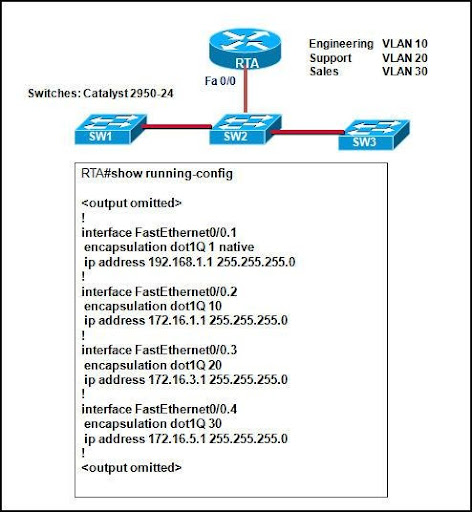
Refer to the exhibit. Based on the output shown, to which IP network should the workstations in the Support department belong?
• 192.168.1.0
• 172.16.1.0
• 172.16.3.0
• 172.16.5.0
2.

Refer to the exhibit. A network administrator is doing proactive network maintenance. The administrator pings 192.168.1.100 and compares the results to the baseline data. Based on the comparison of the two pings, what is one possibility?
• There is an ACL applied, making the destination host unreachable.
• There is a malfunctioning NIC on the destination host.
• The sending host is unable to access the network.
• There are congestion problems on the network.
3.

Refer to the exhibit. Given the output generated by the debug ppp negotiation command, which statement is true?
The line protocol of the local router is now up.
• The username ’Goleta’ is configured locally.
• The command ppp authentication pap is configured on both routers.
• The local router requested to terminate the session.
4. What is important to consider while configuring the subinterfaces of a router when implementing inter-VLAN routing?
• The subinterface numbers must match the VLAN ID number.
• The physical interface must have an IP address configured.
• The IP address of each subinterface must be the default gateway address for each VLAN subnet.
• The no shutdown command must be given on each subinterface.
5.

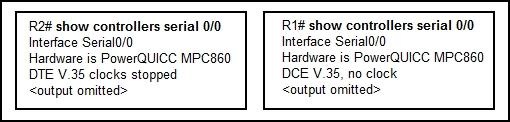
Refer to the exhibit. A lab technician connects two routers together via a serial cable using the default interface configuration values. The interfaces are up; however, the technician is unable to ping between the two devices. What is the most likely problem?
• The lab technician used the wrong cable to connect the serial ports.
• There is an IP mismatch between the serial ports.
• There is an encapsulation mismatch between the serial ports.
• No clock rate has been set on the DCE interface.
6.

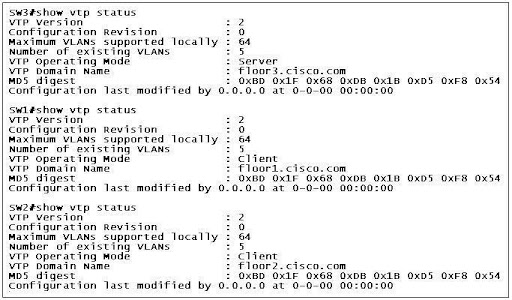
Refer to the exhibit. Based on the output shown, why is VTP information unable to propagate the network?
• One of the two client mode switches must be reconfigured to Transparent mode.
• Each switch must be synchronized to the network time server.
• The VTP domain names are different.
• VTP passwords must be set.
• The configuration revision numbers are all the same.
7. The enterprise mail server software recently went through a minor update. A network administrator notices an excessive amount of traffic between a database server and the newly updated mail server, compared to the baseline data. What is the first action the administrator should do to investigate the problem?
• Wait to see if the recent update will stabilize after a while.
• Redo the baseline data to include the minor upgrade.
• Check the log to see what software components are producing the excess traffic.
• Check for viruses and spyware on the database server.
8.

Refer to the exhibit. Users are reporting that they cannot access the Internet. Routers R1 and R2 are configured with RIP version 2 as shown. If R2 receives a packet with a destination address on the Internet, how is the packet routed?
• The packet is routed to the ISP router and then to network 10.1.1.0/24.
• The packet is routed to the ISP router and then to the Internet.
• The packet is routed to R1 and then forwarded out Fa0/0 on R1.
• The packet will not be routed because R2 does not have a valid default route.
9.

Refer to the exhibit. Both routers are configured using RIPv1. Both routers are sending updates about the directly connected routes. R1 can successfully ping the serial interface of R2. The routing table on R1 does not contain any dynamically learned routes from R2, and the routing table on R2 shows no dynamically learned routes from R1. What is the problem?
• Subnetting is not supported by RIPv1.
• One of the routers needs a clock rate on the serial interface.
• The serial link between the two routers is unstable.
• VLSM is not supported by RIPv1.
10.
Refer to the exhibit. Host 192.168.1.14 is unable to download email from 192.168.2.200. After reviewing the output of the show running-config command, what problem is discovered?
• Access to the SMTP server is denied.
• The destination host address in an ACL statement is incorrect.
• The ACL is applied to the interface in the wrong direction.
• The implicit deny any any is blocking all access to email.
11. An employee called the help desk to report a laptop that could not access a web-based application on the Internet. The help desk technician asked the employee to open a Windows command prompt and type the ipconfig /all command. Which problem-solving technique did the technician choose?
• top-down
• bottom-up
• substitution
• divide-and-conquer
12.

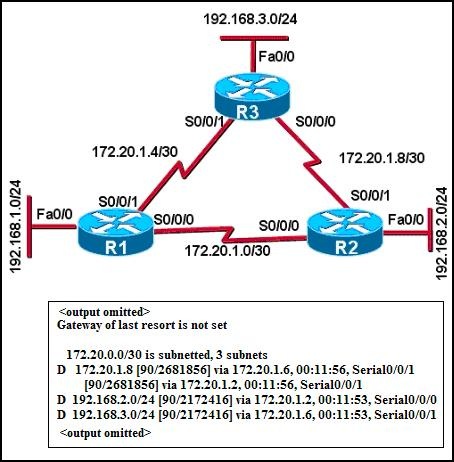
Refer to the exhibit. Based on the network diagram and the output shown, which statement is true?
• The command was entered on router R1.
• The command was entered on router R2.
• The command was entered on router R3.
• The command could have been entered on either R1 or R2.
13.

Refer to the exhibit. An ACL is configured to prevent access by network 192.168.1.0 to network 192.168.2.0, but it is not working properly. What problem is discovered after observing the output of the show running-config command?
• The protocol type specified in the ACL should be TCP, not IP.
• The source and destination addresses are reversed in the statement.
The ACL is applied to the wrong interface, but the right direction.
• The ACL is applied to the wrong interface and the wrong direction.
• The permit ip any any statement allows network 192.168.1.0 access.
14.

Although all networks are reachable, the network administrator notices abnormal routing behavior after configuring OSPF on each router. According to the partial output from the debug ip ospf events command, which statement is true about the contents of the routing table in RA?
• It will show network 172.16.3.0 learned from RB.
• It will show network 172.16.3.0 learned from RC.
• It will show two equal routes to network 192.168.1.4/30.
• It will show two equal routes to network 192.168.1.8/30.
15. A network at a large building failed, causing a severe disruption in business activities. The problem was eventually detected and resolved by replacing a piece of failed network equipment. Investigation led to the conclusion that a network design problem was the main cause of the disruption. Loss of a single piece of equipment should not have been able to cause such a large problem. What two terms best describe this type of design weakness? (Choose two.)
• bottleneck
• limited availability
• limited scalability
• large failure domain
• single point of failure

• limited staff capabilities
16.

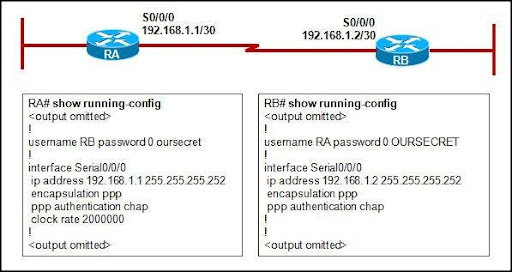
Refer to the exhibit. The network administrator is troubleshooting the connectivity issue between RA and RB. According to the partial configuration, what is the cause of the problem?
• password mismatch for PPP authentication
• username mismatch for PPP authentication
• encapsulation method mismatch for PPP authentication
• authentication method mismatch for PPP authentication
17.

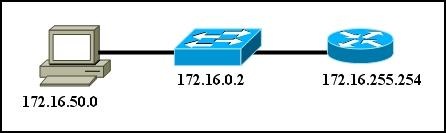
Refer to the exhibit. ABC Company is using the 172.16.0.0/18 network. It is standard company practice to use the first 50 addresses for switches and servers and assign the last usable address to the router. The remaining addresses are assigned to the hosts. After assigning the addresses, the network technician tests connectivity from the host above and is not able to ping the router. What could be the problem?
• The router was assigned the broadcast address.
• The host is not in the same subnet as the switch and router.
• The router interface is in the wrong subnet.
• The host was assigned a network address.
18.

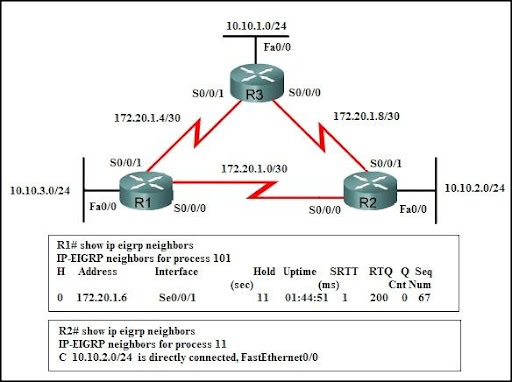
Refer to the exhibit. A network administrator is troubleshooting a problem. No users are able to access the 10.10.2.0/24 network, but are able to access all other networks. Assuming R3 is configured correctly and based on the output shown, what is most likely the problem?
• There is congestion on the 10.10.2.0 network.
• The EIGRP process number on R2 is incorrect.
• The Fa0/0 interface on R2 is shut down.
• The Fa0/0 interface on R2 has an incorrect IP address or subnet mask.
19.

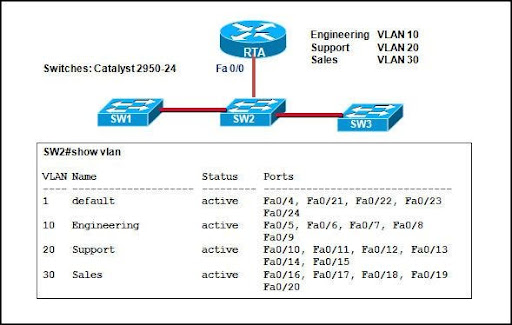
Refer to the exhibit. The network administrator correctly configures RTA to perform inter-VLAN routing. Using the show vlan command, the administrator verifies that port Fast Ethernet 0/4 is the first available port in the default VLAN on SW2. The administrator connects RTA to port 0/4 on SW2, but inter-VLAN routing does not work. What could be the possible cause of the problem with the SW2 configuration?
• Port 0/4 is not active.
• Port 0/4 must be a member of VLAN1.
• Port 0/4 is configured in access mode.
• Port 0/4 is configured as a trunk port.
20.

Refer to the exhibit. The network administrator is unable to ping from the console of router R3 to host 10.10.4.63. What is the problem?
• RIPv1 does not support VLSM.
• Router R2 does not have RIP correctly configured.
• Router R3 is missing a network statement for network 10.0.0.0.
• There is an addressing problem on the link between routers R2 and R3.
21.

Refer to the exhibit. A network administrator has implemented subnetting using the network 192.168.25.0 and a /28 mask. Workstation 1 is not able to ping with Workstation 2. What is a possible cause for this lack of communication?
• Workstation 1 and Workstation 2 are on the same subnet.
• The serial connections are using addresses from the LAN subnets.
• All hosts in the network must be in the same subnet to communicate.
• Workstation 1 is not on the same network that the RTA router LAN interface is on.
22. Which two statements describe when a network administrator should perform a network baseline? (Choose two.)
• It should be done monthly as a minimum standard.
• It should be performed when all switch Cisco IOS versions are upgraded.
• It should be done when all network printers are upgraded to a new model.
• It should be done when the network is performing at normal activity levels.
• It should be done whenever an SLA has been signed with a new service provider

CCNA Discovery 3 Module 8 Exam Answers Version 4.0

1.

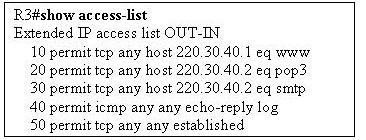
Refer to the exhibit. A network administrator needs to add the command deny ip 10.0.0.0 0.255.255.255 any log to R3. After adding the command, the administrator verifies the change using the show access-list command. What sequence number does the new entry have?
• 0
• 10, and all other items are shifted down to the next sequence number
• 50
• 60
2.

Refer to the exhibit. What happens if the network administrator issues the commands shown when an ACL called Managers already exists on the router?
• The new commands overwrite the current Managers ACL.
• The new commands are added to the end of the current Managers ACL.
• The new commands are added to the beginning of the current Managers ACL.
• An error appears stating that the ACL already exists.
3. Why are inbound ACLs more efficient for the router than outbound ACLs?
• Inbound ACLs deny packets before routing lookups are required.
• Inbound ACL operation requires less network bandwidth than outbound.
• Inbound ACLs permit or deny packets to LANs, which are typically more efficient than WANs.
• Inbound ACLs are applied to Ethernet interfaces, while outbound ACLs are applied to slower serial interfaces.
4.
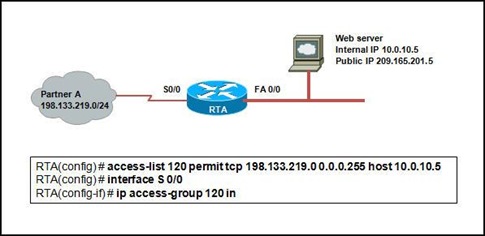
Refer to the exhibit. The network administrator of a company needs to configure the router RTA to allow its business partner (Partner A) to access the web server located in the internal network. The web server is assigned a private IP address, and a static NAT is configured on the router for its public IP address. Finally, the administrator adds the ACL. However, Partner A is denied access to the web server. What is the cause of the problem?
• Port 80 should be specified in the ACL.
• The public IP address of the server, 209.165.201.5, should be specified as the destination.
• The ACL should be applied on the s0/0 outbound interface.
• The source address should be specified as 198.133.219.0 255.255.255.0 in the ACL.
5. ACL logging generates what type of syslog message?
• unstable network
• warning
• informational
• critical situation
6. Which two host addresses are included in the range specified by 172.16.31.64 0.0.0.31? (Choose two.)
• 172.16.31.64
• 172.16.31.77
• 172.16.31.78

• 172.16.31.95
• 172.16.31.96
7. Traffic from the 64.104.48.0 to 64.104.63.255 range must be denied access to the network. What wildcard mask would the network administrator configure in the access list to cover this range?
• 0.0.15.255
• 0.0.47.255
• 0.0.63.255
• 255.255.240.0
8. ACLs are used primarily to filter traffic. What are two additional uses of ACLs? (Choose two.)
• specifying source addresses for authentication
• specifying internal hosts for NAT
• identifying traffic for QoS

• reorganizing traffic into VLANs
• filtering VTP packets
9. What can an administrator do to ensure that ICMP DoS attacks from the outside are mitigated as much as possible, without hampering connectivity tests initiated from the inside out?
• Create an access list permitting only echo reply and destination unreachable packets from the outside.
• Create an access list denying all ICMP traffic coming from the outside.
• Permit ICMP traffic from only known external sources.
• Create an access list with the established keyword at the end of the line.
10. What effect does the command reload in 30 have when entered into a router?
• If a router process freezes, the router reloads automatically.
• If a packet from a denied source attempts to enter an interface where an ACL is applied, the router reloads in 30 minutes.
• If a remote connection lasts for longer than 30 minutes, the router forces the remote user off.
• A router automatically reloads in 30 minutes.
11.
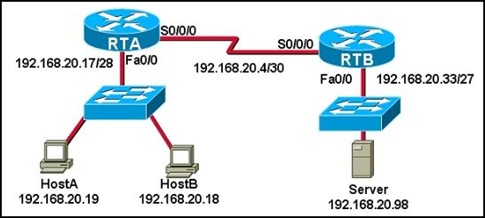
Refer to the exhibit. The following commands were entered on RTB.
RTB(config)# access-list 4 deny 192.168.20.16 0.0.0.15
RTB(config)# access-list 4 permit any
RTB(config)# interface serial 0/0/0
RTB(config-if)# ip access-group 4 in
Which addresses do these commands block access to RTB?
• 192.168.20.17 to 192.168.20.31
• 192.168.20.16 to 192.168.20.31*
• 192.168.20.16 to 192.168.20.32
• 192.168.20.16 to 192.168.20.33
12.

Refer to the exhibit. The new security policy for the company allows all IP traffic from the Engineering LAN to the Internet while only web traffic from the Marketing LAN is allowed to the Internet. Which ACL can be applied in the outbound direction of Serial 0/1 on the Marketing router to implement the new security policy?
• access-list 197 permit ip 192.0.2.0 0.0.0.255 any
access-list 197 permit ip 198.18.112.0 0.0.0.255 any eq www
• access-list 165 permit ip 192.0.2.0 0.0.0.255 any
access-list 165 permit tcp 198.18.112.0 0.0.0.255 any eq www
access-list 165 permit ip any any
• access-list 137 permit ip 192.0.2.0 0.0.0.255 any
access-list 137 permit tcp 198.18.112.0 0.0.0.255 any eq www

• access-list 89 permit 192.0.2.0 0.0.0.255 any
access-list 89 permit tcp 198.18.112.0 0.0.0.255 any eq www
13. Which three statements are true concerning standard and extended ACLs? (Choose three.)
• Extended ACLs are usually placed so that all packets go through the network and are filtered at the destination.
• Standard ACLs are usually placed so that all packets go through the network and are filtered at the destination.
• Extended ACLs filter based on source address only, and must be placed near the destination if other traffic is to flow.
• Standard ACLs filter based on source address only, and must be placed near the destination if other traffic is to flow.
• Extended ACLs filter with many possible factors, and they allow only desired packets to pass through the network if placed near the source.

• Standard ACLs filter with many possible factors, and they allow only desired packets to pass through the network if placed near the source.
14.
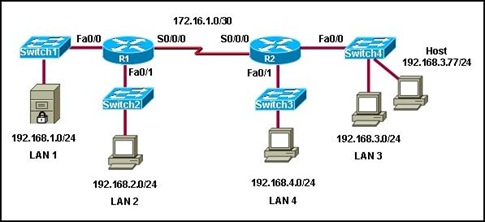
Refer to the exhibit. Company policy for the network that is shown indicates the following guidelines:
1) All hosts on the 192.168.3.0/24 network, except host 192.168.3.77, should be able to reach the 192.168.2.0/24 network.
2) All hosts on the 192.168.3.0/24 network should be able to reach the 192.168.1.0/24 network.
3) All other traffic originating from the 192.168.3.0 network should be denied.
Which set of ACL statements meets the stated requirements when they are applied to the Fa0/0 interface of router R2 in the inbound direction?
• access-list 101 deny ip any any
access-list 101 deny ip 192.168.3.77 0.0.0.0 192.168.2.0 0.0.0.255
access-list 101 permit ip 192.168.3.0 0.0.0.255 192.168.2.0 0.0.0.255
access-list 101 permit ip 192.168.3.0 0.0.0.255 192.168.1.0 0.0.0.255
• access-list 101 permit ip 192.168.3.0 0.0.0.255 192.168.2.0 0.0.0.255
access-list 101 deny ip 192.168.3.77 0.0.0.0 192.168.2.0 0.0.0.255
access-list 101 permit ip 192.168.3.0 0.0.0.255 192.168.1.0 0.0.0.255
access-list 101 deny ip 192.168.3.77 0.0.0.0 192.168.2.0 0.0.0.255
access-list 101 permit ip 192.168.3.0 0.0.0.255 192.168.2.0 0.0.0.255
access-list 101 permit ip 192.168.3.0 0.0.0.255 192.168.1.0 0.0.0.255

• access-list 101 permit ip 192.168.3.0 0.0.0.255 192.168.2.0 0.0.0.255
access-list 101 deny ip 192.168.3.77 0.0.0.0 192.168.2.0 0.0.0.255
access-list 101 permit ip 192.168.3.0 0.0.0.255 192.168.1.0 0.0.0.255
access-list 101 permit ip any any
• access-list 101 deny ip 192.168.3.77 0.0.0.0 192.168.2.0 0.0.0.255
access-list 101 permit ip 192.168.3.0 0.0.0.255 192.168.0.0 0.0.255.255
15.
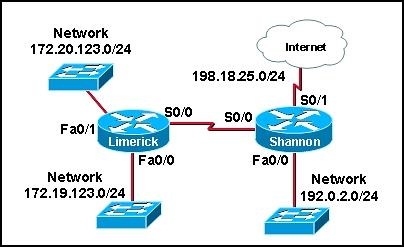
Hosts from the Limerick LAN are not allowed access to the Shannon LAN but should be able to access the Internet. Which set of commands will create a standard ACL that will apply to traffic on the Shannon router interface Fa0/0 implementing this security?
• access-list 42 deny 172.19.123.0 0.0.0.255 192.0.2.0 0.0.0.255
access-list 42 permit any
• access-list 56 deny 172.19.123.0 0.0.0.255
access-list 56 permit any

• access-list 61 deny 172.19.123.0 0.0.0.0
access-list 61 permit any
• access-list 87 deny ip any 192.0.2.0 0.0.0.255
access-list 87 permit ip any
16.
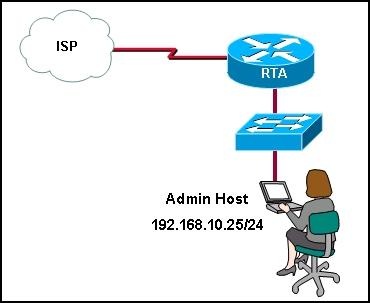
Refer to the exhibit. A network administrator needs to configure an access list that will allow the management host with an IP address of 192.168.10.25/24 to be the only host to remotely access and configure router RTA. All vty and enable passwords are configured on the router. Which group of commands will accomplish this task?
• Router(config)# access-list 101 permit tcp any 192.168.10.25 0.0.0.0 eq telnet
Router(config)# access-list 101 deny ip any any
Router(config)# int s0/0
Router(config-if)# ip access-group 101 in
Router(config-if)# int fa0/0
Router(config-if)#ip access-group 101 in

• Router(config)# access-list 10 permit 192.168.10.25 eq telnet
Router(config)# access-list 10 deny any
Router(config)# line vty 0 4
Router(config-line)#access-group 10 in
• Router(config)# access-list 86 permit host 192.168.10.25
Router(config)# line vty 0 4
Router(config-line)# access-class 86 in
• Router(config)# access-list 125 permit tcp 192.168.10.25 any eq telnet
Router(config)# access-list 125 deny ip any any
Router(config)# int s0/0
Router(config-if)# ip access-group 125 in
17. Which ACL permits host 10.220.158.10 access to the web server 192.168.3.244?
• access-list 101 permit tcp host 10.220.158.10 eq 80 host 192.168.3.224
• access-list 101 permit tcp 10.220.158.10 0.0.0.0 host 192.168.3.224 0.0.0.0 eq 80
• access-list 101 permit host 10.220.158.10 0.0.0.0 host 192.168.3.224 0.0.0.0 eq 80
• access-list 101 permit tcp 10.220.158.10 0.0.0.0 host 192.168.3.224 eq 80
18. Which wildcard mask would match the host range for the subnet 192.16.5.32 /27?
• 0.0.0.32
• 0.0.0.63
• 0.0.63.255
• 0.0.0.31
19. A security administrator wants to secure password exchanges on the vty lines on all routers in the enterprise. What option should be implemented to ensure that passwords are not sent in clear text across the public network?
• Use Telnet with an authentication server to ensure effective authentication.
• Apply an access list on the router interfaces to allow only authorized computers.
• Apply an access list on the vty line to allow only authorized computers.
• Use only Secure Shell (SSH) on the vty lines.
20.

Refer to the exhibit. An administrator notes a significant increase in the amount of traffic entering the network from the ISP. The administrator clears the access-list counters. After a few minutes, the administrator again checks the access-list table. What can be concluded from the most recent output shown?
• A small amount of HTTP trafic is an indication that the web server was not configured correctly.
• A larger amount of POP3 traffic (compared with SMTP traffic) indicates that there are more POP3 email clients than SMTP clients in the enterprise.
• A large amount of ICMP traffic is being denied at the interface, which can be an indication of a DoS attack.
• A larger amount of email traffic (compared with web traffic) is an indication that attackers mainly targeted the email server.

CCNA Discovery 3 Module 7 Exam Answers Version 4.0

1. Why are Network Control Protocols used in PPP?
• to establish and terminate data links
• to provide authentication capabilities to PPP
• to manage network congestion and to allow quality testing of the link
• to allow multiple Layer 3 protocols to operate over the same physical link
2. What is the data transmission rate for the DS0 standard?
• 44 kb/s
• 64 kb/s
• 1.544 Mb/s
• 44.736 Mb/s
3. In which two layers of the OSI model are key differences found between a LAN and a WAN. (Choose two.)
• Layer 1
• Layer 2

• Layer 3
• Layer 4
• Layer 6
• Layer 7
4. Which statement is true about the Cisco implementation of the HDLC protocol?
• It supports authentication.
• It has a universally compatible frame format.
• It is the default encapsulation for serial interfaces on Cisco routers.
• It does not support multiple protocols across a single link.
5.

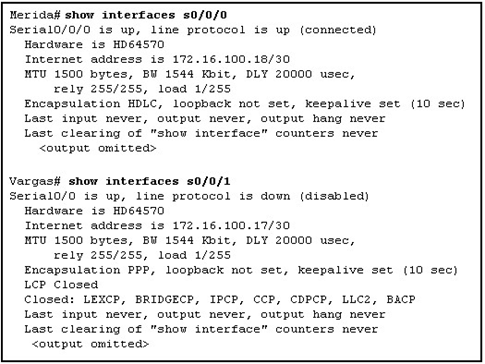
Refer to the exhibit. A network administrator has a connectivity problem between the serial interfaces of Merida and Vargas. What is the cause of the problem?
• Authentication is required on the serial link.
• The encapsulation is misconfigured.
• The IP addresses are on different subnets.
• The serial interface on Vargas is shutdown.
• The loopback interfaces on both routers are not configured.
6.

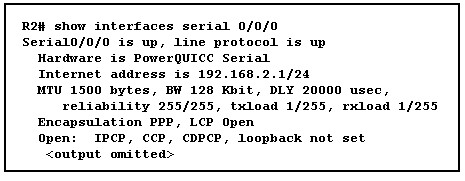
Refer to the exhibit. What statement is true about the exhibited output?
• LCP is in the process of negotiating a link.
• LCP and NCP are waiting for CHAP authentication to complete.
• LCP negotiation has completed successfully, but NCP negotiation is in progress.
• LCP and NCP negotiation is complete, and the data link service is available to carry packets.
7. Which three statements are true regarding LCP? (Choose three.)
• It is responsible for negotiating link establishment.
• It negotiates options for Layer 3 protocols running over PPP.
• It uses MD5 encryption while negotiating link-establishment parameters.
• It terminates the link upon user request or the expiration of an inactivity timer.
• It can test the link to determine if link quality is sufficient to bring up the link.

• It monitors the link for congestion and dynamically adjusts the acceptable window size.
8. Why are Frame Relay paths referred to as virtual?
• Frame Relay PVCs are created and discarded on demand.
• The connections between PVC endpoints act like dialup circuits.
• There are no dedicated circuits to and from the Frame Relay carrier.
• The physical circuits inside the Frame Relay cloud do not contain exclusive links for a specific Frame Relay connection.
9. What best describes the use of a data-link connection identifier (DLCI)?
• an address identifying a virtual circuit
• a logical address identifying the DCE device
• an address identifying a Layer 3 service across a Frame Relay network
• a logical address identifying the physical interface between a router and a Frame Relay switch
10. What two services allow the router to dynamically map data link layer addresses to network layer addresses Frame Relay network? (Choose two.)
• ARP
• ICMP
• Proxy ARP
• Inverse ARP
• LMI status messages

11. Which three statements describe functions of the Point-to-Point Protocol with regards to the OSI model?(Choose three.)
• operates at all layers of the OSI model
• provides a mechanism to multiplex several network layer protocols
• can be configured on both synchronous and asynchronous serial interfaces

• uses Layer 3 of the OSI model to establish and maintain a session between devices
• uses the data link layer to configure such options as error detection and compression
• uses network control protocols to test and maintain connectivity between devices
12. At what physical location does the responsibility for a WAN connection change from the user to the service provider?
• demilitarized zone (DMZ)
• demarcation point
• local loop
• cloud
13. What does a Frame Relay switch use to inform the sender that there is congestion?
• FECN
• BECN
• DE
• FCS
14.

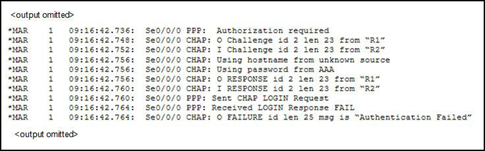
Refer to the exhibit. What statement is true about the debug output?
• R2 is using PAP instead of CHAP.
• The routers have different CHAP passwords configured.
• The administrator performed a shutdown on the R2 PPP interface during negotiation.
• The Layer 3 protocol negotiation caused the connection failure.
15. Which two statements describe the function of time-division multiplexing? (Choose two.)
• Multiple data streams share one common channel.
• Conversations that require extra bandwidth receive any unused time slices.
• Time slots are utilized on a first-come, first-served basis.
• Time slots go unused if a sender has nothing to transmit.
• Priority can be dedicated to one data source.
16. When customers use credit cards to make purchases at a small business, a modem is heard dialing a telephone number to transfer the transaction data to the central office. What type of WAN serial connection is in use?
• leased line
• point-to-point
• circuit switched
• packet switched
17. Which best describes data communications equipment (DCE)?
• serves as data source and/or destination
• responsible for negotiating windowing and acknowledgements
• physical devices such as protocol translators and multiplexers
• equipment that forwards data and is responsible for the clocking signal
18. Permanent virtual circuits and switched virtual circuits are both part of which option for WAN connectivity?
• leased line
• cell switching
• packet switching
• circuit switching
19. Which field of a frame uses error detection mechanisms to verify that the frame is not damaged intransit?
• FCS
• MTU
• flag
• control
• protocol
20. What occurs in the encapsulation process as a data packet moves from a LAN across a WAN?
• The Layer 2 encapsulation changes to a format that is appropriate for the WAN technology.
• The Layer 3 encapsulation changes to a format that is appropriate for the WAN technology.
• Both Layer 2 and Layer 3 encapsulation change to a technology that is appropriate for the WAN.
• Both Layer 2 and Layer 3 encapsulation remain constant as the data packet travels throughout the network.
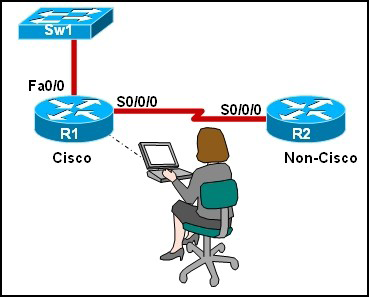
21.

Refer to the exhibit. The network administrator is configuring R1 to connect to R2, which is a non-Cisco router. Which encapsulation method will need to be configured for communication to occur?
• HDLC
• HSSI
• ISDN
• IPCP
• PPP
22. A company is implementing dialup services for remote workers to connect to the local network. The company uses multiple Layer 3 protocols and requires authentication for security. Which protocol should be used for this remote access?
• LMI
• PPP
• HDLC
• Frame Relay
23. Which two options can LCP negotiate? (Choose two.)
• compression
• authentication

• dynamic flow control
• network layer address for IP
• connection-oriented or connectionless communication methods
24. What statement best describes cell switching?
• It uses a dedicated path between endpoints.
• It creates a permanent physical link between two points.
• It uses DLCIs to identify virtual circuits.
• It creates fixed-length packets that traverse virtual circuits

CCNA Discovery 3 Module 6 Exam Answers Version 4.0

1.

Refer to the exhibit. What statement describes the DR/BDR relationship of the HQ router?
• HQ is the DR.
• HQ is the BDR.
• HQ is a DROTHER.
• HQ is a member of an NBMA network.
2. Which two features are associated with Frame Relay OSPF point-to-multipoint environments? (Choose two.)
• A DR is not elected.
• The OSPF priority value determines the active DR on the Frame Relay link.
• OSPF neighbor routers are statically defined.
• The link types are identified as broadcast multiaccess.
• The BDR will have a router ID whose value is greater than the DR router ID.
3.

Refer to the exhibit. How was the OSPF default gateway entry for R2 determined?
• Default routes are automatically injected by OSPF into all advertisements.
• A static default gateway route is defined in the configuration of R2.
• The default-information originate command is applied on R1.
• The ISP defines the gateway of last resort and automatically passes it to R1 and R2.
• The ip default-gateway command is applied on R2.
4. What is always required for OSPF routers to share routing information?
• designated routers
• a backup designated router
• neighbor adjacencies
• an NBMA network topology
• links that are configured on the 224.0.0.0 network
5.

Refer to the exhibit. A network administrator has implemented OSPF and the network has converged. If all router interfaces are enabled and functional, what route will OSPF view as lowest cost when moving frames from Host3 to Host1?
• R3 to R4 to R1
• R3 to R1
• R3 to R2 to R1
• R3 to R5 to R2 to R1
6.

Refer to the exhibit. Which commands configure router A for OSPF?
• router ospf 1
network 192.168.10.0
• router ospf 1
network 192.168.10.64 0.0.0.63 area 0
network 192.168.10.192 0.0.0.3 area 0
• router ospf 1
network 192.168.10.64 255.255.255.192
network 192.168.10.192 255.255.255.252
• router ospf 1
network 192.168.10.0 area 0
7.

Refer to the exhibit. Which network statement configures the home router to allow all the interfaces to participate in OSPF?
• network 10.0.0.0 0.3.255.255 area 0
• network 10.8.0.0 0.0.0.3 area 0
• network 10.8.0.0 0.3.255.255 area 0
• network 10.10.0.0 0.0.0.3 area 0
• network 10.12.0.0 0.3.255.255 area 0
8. Which statement is true regarding OSPF DR and BDR elections?
• A new DR/BDR election occurs each time a new OSPF neighbor is added.
• The router with the highest OSPF priority setting wins the election for DR.
• The default priority value for a router connected to a multi-access network is 0.
• The router with the highest MAC address is elected as the DR when the default priority values are used.
9.

Refer to the exhibit. The network administrator would like only the 172.16.32.0 network advertised to Router1. Which OSPF network command accomplishes this?
• Router2(config-router)# network 172.16.0.0 0.0.0.15 area 0
• Router2(config-router)# network 172.16.0.0 0.0.15.255 area 0
• Router2(config-router)# network 172.16.32.0 0.0.15.255 area 0
• Router2(config-router)# network 172.16.32.0 0.0.255.255 area 0
10. Which two statements describe the operation of link-state routing protocols? (Choose two.)
• All routers in the same area have identical link-state databases when converged.
• Routing loops are prevented by running the Diffusing Update Algorithm (DUAL).
• Link-state routers send frequent periodic updates of the entire routing table.
• Reliable Transport Protocol (RTP) is used to deliver and receive LSAs.
• Calculating the shortest path for each destination is accomplished with the SPF algorithm.
11.

Refer to the exhibit. Routers A, B, and C are part of the existing OSPF network. Router D has been added to the network. All routers are running OSPF and have the indicated priorities applied to the interface. What is the DR/BDR status immediately after router D is added to the existing network?
• An election is forced and router D wins the DR election.
• The DR and BDR do not change until the next election.
• An election is forced and the existing BDR becomes the DR.
• The router with the highest router ID becomes the new BDR.
12. Which two statements describe the use of OSPF DR/BDR elections? (Choose two.)
• Elections are always optional.
• Elections are required in all WAN networks.
• Elections are required in point-to-point networks.
• Elections are required in broadcast multiaccess networks.
• Elections are sometimes required in NBMA networks.

13.

Refer to the exhibit. As part of an OSPF network, R1 and R2 are trying to become adjacent neighbors. Although it appears that the two systems are communicating, neither of the routing tables include OSPF routes received from its neighbor. What could be responsible for this situation?
• R1 and R2 are not on the same subnet.
• The Process IDs on each router do not match.
• The timer intervals on the routers do not match.
• The value set for the Transmit Delay time on both routers is too low.
14.

Refer to the exhibit. What is the purpose of the value 128 shown in bold?
• It is the OSPF cost metric.
• It is the OSPF administrative distance.
• It is the value assigned by the Dijkstra algorithm that designates the distance in hops to the network.
• It is the value assigned to an interface that is used by the DUAL algorithm to determine the metric.
15.

Refer to the exhibit. What is the purpose of the configuration commands added on router B?
• allows router A to form an adjacency with router B
• provides a stable OSPF router ID on router B
• provides a method of testing router traffic
• creates the OSPF adjacency table on router B
16.

Refer to the exhibit. The command ip route 10.16.1.64 255.255.255.252 s0/0/0 is entered into the router. Why does network 10.16.1.64/30 appear in the routing table in addition to network 10.16.1.64/27?
• The router views 10.16.1.64/30 and 10.16.1.64/27 as two different networks.
• The static route is used as a backup route for packets destined for 10.16.1.64/27.
• The AD for static routes is lower than the AD for OSPF routes.
• The static route metric is lower than the OSPF metric for the 10.16.1.64/27 network.
17. What is the primary difference between link-state protocols and distance vector protocols with regard to route calculation?
• Distance vector protocols take existing routes from their neighbors and add to them. Link-state protocols independently calculate full routes.
• Link-state protocols calculate and pass full routing tables to all routers in their associated areas, and distance vector protocols do not.
• When determining invalid routes, link-state protocols use split horizon for all route computations. Distance vector protocols use reverse poisoning.
• Distance vector protocols require more CPU and RAM for route calculations than link-state protocols require.
18. What range of networks are advertised in the OSPF updates by the command Router1(config-router)# network 192.168.0.0 0.0.15.255 area 0?
• 192.168.0.0/24 through 192.168.0.15/24
• 192.168.0.0/24 through 192.168.15.0/24
• 192.168.15.0/24 through 192.168.31.0/24
• 192.168.15.0/24 through 192.168.255.0/24
• 192.168.16.0/24 through 192.168.255.0/24
19.

Refer to the exhibit. When establishing adjacency relationships, which IP address would router A use to send hello packets to router B?
• 10.11.0.1
• 10.11.0.2
• 10.11.0.255
• 224.0.0.5
• 255.255.255.255
20.

Refer to the exhibit. Which router will be elected the DR and which will become the BDR?
• R1 will be DR and R2 will be BDR.
• R1 will be DR and R3 will be BDR.
• R2 will be DR and R1 will be BDR.
• R2 will be DR and R3 will be BDR.
• R3 will be DR and R2 will be BDR.
• R3 will be DR and R1 will be BDR.
21. When compared to a distance vector routing protocol, what is a benefit of the hierarchical design approach that is used in large OSPF networks?
• simpler configuration
• reduction of router processing requirements
isolation of network instability
• less complex network planning
22. What are two advantages of using a link-state routing protocol instead of a distance vector routing protocol? (Choose two.)
• The topology database eliminates the need for a routing table.
• Frequent periodic updates are sent to minimize the number of incorrect routes in the topological database.
• Routers have direct knowledge of all links in the network and how they are connected.
• After the initial LSA flooding, routers generally require less bandwidth to communicate changes in a topology.

• A link-state routing protocol requires less router processor power.
23. If a network has converged, what is true about the link-state database held by each router in the same OSPF area?
• Each router has a link-state database containing the same status information.
• Each router has a different link-state database depending on its position within the network.
• The link-state database is stored in a designated router and is accessed by each router in the area as needed.
• The link-state database in each router only contains information about adjacent routers and the status of their links.
24.

Refer to the exhibit. RTRC was recently configured and is not sending the proper OSPF routes to RTRB, as shown in the RTRB routing table. Based on the RTRC configuration, what is most likely the problem?
• RTRC interfaces are administratively shut down.
• The OSPF process ID for RTRC does not match the process ID used on RTRB.
• The interface addresses on RTRC overlap with other addresses in the network.
• The OSPF routing configuration on RTRC has a missing or incorrect network statement.